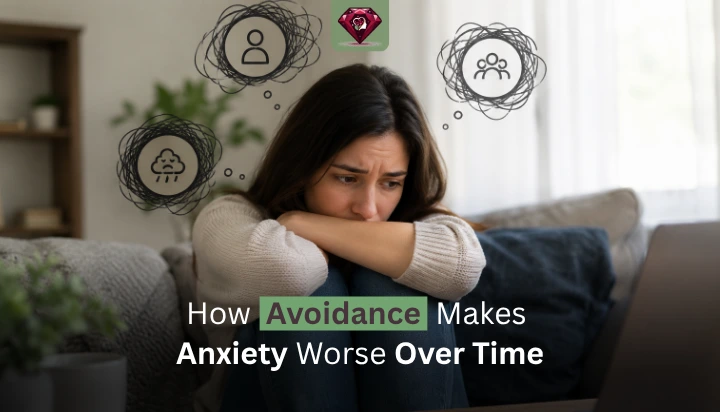
You hear your heart rate rise at the notion of a social event, a professional presentation, or even a phone call. You walk away, find a cause to walk away, delay, or cancel to feel better right now. Relief comes swiftly, and for a little while the anxiousness is gone. But over time, the anxiety seems to become larger, and the list of things you avoid seems to grow longer. If this trend seems familiar, you are not alone.
Avoidance is one of the most typical ways people try to cope with anxiety. And that’s perfectly reasonable in the short term. What helps to decrease anxiety now typically silently cements it over time. Recognizing this loop can help you stop blaming yourself and open the door to more useful ways of dealing with the problem.
What Avoidance Looks Like in Daily Life
Avoidance isn’t always dramatic. It can manifest in subtle, daily ways:
- Refusing invitations, arriving late or leaving early
- Postponing emotionally intense discussions, emails, or choices
- Staying active so you have less quiet time for worrying thoughts.
- Using distractions, seeking reassurance, or over-preparing to avoid discomfort
- Steering clear of locations, subjects, or individuals that have been associated with anxiety
These approaches tend to feel protective. They provide relief from acute distress and can seem like the only sensible choice when anxiety is high. The problem is that the respite they bring is transient, and the long-term expense is likely to be higher.
Why the Brain Chooses Avoidance
Your nervous system is meant to protect you from danger. When something feels dangerous, even if the risk is emotional rather than physical, the brain prioritizes escape or safety. Avoidance offers fast alleviation and is registered by the brain as successful protection.
That builds a robust learning loop over time. The brain learns that the avoided scenario is something to fear and that avoiding it is the way to be safe. The more avoidance is utilized, the stronger this relationship is. What starts as a temporary coping mechanism can gradually turn into a default response.
This is not a flaw of character. It is the nervous system performing what it evolved to do. The problem is that the same mechanism that used to benefit can start to constrain life in meaningful ways.
How Avoidance Strengthens Anxiety Over Time
Avoidance maintains and increases anxiety via numerous interrelated processes:
- It blocks new learning. You never learn by avoiding a scenario in which the dreaded outcome may not happen or that you can handle suffering.
- Increased sensitivity: The less you practice being in the presence of anxiety, the more powerful the experience can become once it does arrive.
- It narrows your world. Avoiding more circumstances can make daily life smaller and more confined, which frequently increases overall stress and isolation.
- It breeds self-doubt. Repeated avoidance can establish a tale that you can’t manage certain things, further lowering confidence.
What results is a self-perpetuating cycle: worry causes avoidance, avoidance produces short-term respite, and this relief further entrenches the fear for next time. The cycle tends to extend, not to resolve itself, unremittingly.
Breaking the Cycle Gently
To get away from avoidance, you don’t have to push yourself into daunting situations. A more lasting method is to take moderate, supported moves that assist your nervous system in learning safety in new ways.
Helpful practices include:
- Start with tiny, reasonable exposures; don’t make large leaps
- Pair difficult conditions with grounding practices to provide your body skills for regulation
- Notice and recognize the temptation to avoid without acting on it right away
- Take time to recognize tiny achievements in being present, not just the result
- Decreasing secondary avoidance behaviors such as over-reassurance seeking or over-preparation when they perpetuate the cycle
Progress is seldom linear. Some days will be easier than others. The aim is not to get rid of worry altogether but to regain a feeling of competence and to increase the variety of situations that you can pass through more easily.
When Professional Mental Health Support Makes a Real Difference
If avoidance is seriously affecting your work, relationships, or daily functioning, expert support will allow you to break the loop more successfully. Supportive psychotherapy offers you a safe space to explore your individual patterns and to try out different answers at your own speed. Approaches that gently address avoidance and improve abilities in emotional regulation tend to be highly useful.
Ruby Reflections Mental Health provides compassionate care for anxiety and the patterns that sustain it. We work with individuals via secure telehealth and tailored therapy to build tools that help them confront discomfort more confidently and lessen the long-term grip of avoidance.
Conclusion
Avoidance gives short-term relief from worry, but over time it tends to make the anxiety stronger and life smaller. But it is not a personal weakness. It is a nervous system that learns what provides immediate safety.
The encouraging truth is that the same learning system can be pointed in a different direction. With awareness, gradual practice, and help when needed, many people discover that situations they once avoided become more manageable and anxiety loses some of its power.
You don’t need to figure out this pattern on your own. Knowing the cycle is already a start in the right direction. Feel free to share this guide with anyone who may know the same struggle. We are here at Ruby Reflections Mental Health whenever you are ready to take the next step toward greater freedom and ease.
FAQs
Does avoiding anxiety make it better or worse?
Avoidance lessens discomfort in the moment but generally increases anxiety over time, blocking new learning and increasing sensitivity.
Why does avoidance feel so hard to stop?
It works well enough and fast, so the brain remembers it as a good safety technique. The drive to avoid gets stronger with repetition.
Is all avoidance unhealthy?
Not necessarily. Taking a step back for a while can help. The problem begins when avoidance is the main, or increasing, strategy of dealing with anxiety.