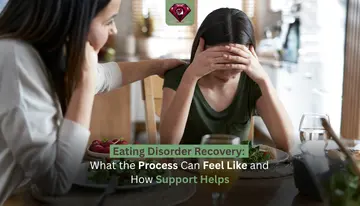
The initial stage of eating disorder treatment can be overwhelming, and you might be thinking, “What now?” Recovery isn’t always a straight line, but with the correct support, healing is achievable.
At Ruby Reflections Mental Health, we guide individuals and families through recovery with confidence, using compassionate care. Knowing what to expect might help reduce the uncertainty and remind you that you don’t have to walk this road alone.
What Eating Disorder Recovery Can Feel Like
Recovery is an emotional roller coaster. Relief that something is finally changing can be accompanied by dread, grief, or resistance. You may have become reliant on the eating disorder as a means of feeling in control, or safe, in stressful times, so letting go of those habits might feel frightening, even if you acknowledge they are unhealthy.
Many people find early in recovery that they are much more aware of feelings they had previously dulled or controlled by way of the disease. As we begin to let go of old ways of coping, feelings of anxiety, melancholy, impatience, or emptiness may begin to come more to the surface. This is a typical factor when the mind and body are learning new ways of coping with stress and discomfort.
Progress is rarely linear. There will be days when you feel clear and loving towards yourself, and there will be days when you feel doubt or the want to fall back into old patterns. Such swings are not a failure. They depict the brain and body changing to healthier ways of living.
Common Emotional and Practical Experiences Along the Way
Recovery is not just changing the diet. It’s about identity, relationships and day-to-day stuff.
Emotional ups and downs
Today you may be proud of little steps, frustrated the next day. It is natural to mourn the loss of time or the way relationships have changed. And the gradual rediscovery of hobbies, energy, and a more real self.
Physical and mental shifts
While the body is attempting to re-balance itself, energy levels, concentration, and mood may vary. It can take some time for your hunger cues and sleep cues to become more consistent. These changes take patience; patience is a big part of the process.
Social and relational changes
At first, mealtimes and social encounters with food can feel charged. Friends and relatives may not quite grasp what you’re going through. Isolation or desire for clearer communication can result. Often, rehabilitation strengthens relationships as honesty and connection increase.
Identity and self-worth
Many people in recovery have to fight deeply held assumptions about their worth, control, and looks. Developing a sense of worth not dependent on the eating disorder takes time and patient practice.
Related Read: The Hidden Psychology Behind Eating Disorders
How Support Makes a Meaningful Difference
Recovery is possible on your own in some ways, but consistent, compassionate support significantly improves the experience and outcomes. Support helps in several key ways:
- It provides a safe space to process difficult emotions without judgment.
- It offers structure and accountability while still respecting your pace.
- It helps you develop new coping skills for stress, anxiety, and body image challenges.
- It reduces isolation and reminds you that you do not have to carry everything alone.
Support can come from trusted friends or family, peer communities, and professional care. Professional support is especially valuable because it combines emotional understanding with evidence-informed approaches tailored to eating disorder recovery.
Practical Ways to Navigate the Recovery Process
These gentle practices can support the journey whether you are just beginning or further along:
Practice self-compassion daily
Speak to yourself how you would speak to a good friend who is struggling. Harsh self-criticism has a way of amplifying impulses; compassion has a way of diminishing them.
Build small, consistent routines
Regularity of meals, sleep, and gentle movement (if appropriate) helps to reinstate a feeling of safety and predictability to body and mind.
Name emotions as they arise
Just by saying “I’m feeling anxious right now” or “This is hard today” might diminish the sensation’s power and allow room for healthier reactions.
Limit comparison and triggering content
Guard your head against anything that encourages comparison or inflexible thinking about food and bodies.
Celebrate non-scale victories
Notice gains in energy, mood, relationships, or your ability to sit with uncomfortable feelings. These signs of recovery mean a lot.
When Professional Mental Health Support Makes a Real Difference
If your eating disorder is adversely affecting your physical health, your mental health, your relationships, or your day-to-day functioning, reaching out for professional treatment is a vital, caring step. Supportive psychotherapy offers a secure and structured setting for detecting underlying problems, developing new skills, and working through the emotional aspects of recovery. A personalized psychiatric evaluation can also help address co-occurring conditions such as anxiety, depression, or trauma that often accompany eating disorders.
At Ruby Reflections Mental Health, we offer practical help and assistance for eating disorders to individuals and families through the highs and lows of rehabilitation.
Conclusion
Recovery from an eating disorder is a journey to rediscover your connection with food, your body and yourself. It might be chaotic, unpredictable and emotionally painful at times, but it can also provide deep relief, greater freedom and a stronger sense of self-worth.
You don’t have to know all the answers to begin. Support makes the journey less lonely, more bearable. With patience, self-compassion and the correct coaching, genuine rehabilitation is achievable.
If you or someone you love is thinking about recovery or going through it, you are not alone. Please feel free to pass this along to anyone who may need it. At Ruby Reflections Mental Health, we are here for you. Contact us when you are ready to take the next step in your healing journey.
FAQs
What does eating disorder recovery actually feel like?
Usually relief, fear, emotional troughs, and tiny increments of energy, mood, and connection to yourself.
Is recovery a straight line?
Not at all. Most people endure setbacks and volatility. These are regular components of the process; they are not signals that you have failed.
How does professional support help in recovery?
Provides a safe space, practical tools, accountability, and support to work on underlying emotional patterns.