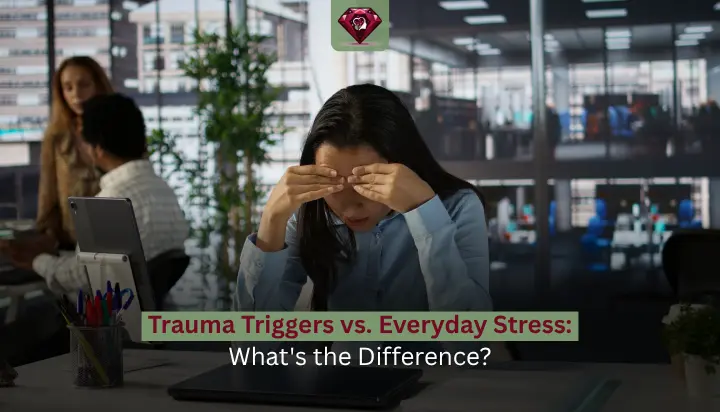
Some days seem heavy for obvious reasons: a tight deadline, an unpleasant conversation, a large to-do list. You may suddenly feel overwhelmed, on edge, or shut down by a certain sound, smell, place, or tone of voice. The emotion can feel stronger than the moment warrants, which can be puzzling or even frustrating.
Understanding the distinction between everyday stress and trauma triggers can help to bring some clarity. It helps you answer yourself more accurately and with more compassion, and it can show you when you need more support. This post covers both sensations in simple, practical language so you can better recognize what is happening in your mind and body.
What Everyday Stress Looks Like
Stress is the body and mind’s reaction to the pressures and demands of the moment. These are situations that feel hard but are often grounded in the present moment.
Examples include work responsibilities, family duties, financial issues, health complications, traffic, or social engagements. Your nervous system will step in to help you cope with the pressure; your heart rate may go up, your muscles will tighten, and your focus will sharpen. Usually, once the event is over, or you use coping skills, your body returns to a calmer baseline.
Everyday stress seems proportional to what is happening. This can be painful and exhausting but often still allows for problem-solving, rest, or diversion. Many people get this regularly, and with help or simple recovery strategies, they recover over time.
What Trauma Triggers Are
Trauma triggers are signals that the nervous system identifies with a past overpowering or dangerous event. Cues can be external (e.g., sound, fragrance, place, anniversary, or type of interaction) or internal (e.g., physical experience, emotion, or cognition). When a trigger is activated, the body and mind respond as if the initial threat is happening all over again-even if the immediate context is safe.
This response isn’t a weakness or a choice. That’s your nervous system trying to safeguard you based on what it learned from a bad event. Reactions can include intense fear, rage, despair, numbness, feeling unreal, or a strong urge to leave or freeze. Some people experience flashbacks or intense sensory memories, too.
Triggers might appear out of nowhere and feel disproportionate to what is happening in the present. That discrepancy is one of the biggest clues that a trauma-related response may be going on.
Key Differences Between Trauma Triggers and Everyday Stress
Both can feel intense, but certain patterns help separate them:
- Link to the past: Daily stress is mostly about present situations. Trauma triggers are frequently linked to past experiences, even if the connection is not immediately apparent.
- Sense of proportion: Stress is usually proportional to the size of the existing demand. Reactions to triggers can feel far greater or more pressing than what the current situation calls for.
- Body and emotional intensity: Both entail activation of the body, but trauma responses may involve stronger flooding, shutdown, or a feeling of being taken out of the present.
- Recovery pattern: Stress usually decreases with decreasing demand or after rest and coping. Trigger reactions can continue or quickly recur with similar signals.
- Feeling safe: While the average person may be stressed out, they still know that they are safe at their core. When a trigger is strong, the nervous system may temporarily override that awareness.
These lines are not always crisp. Stress can build up and feel like a lot, and trauma responses might be mild. It is often more instructive to see patterns through time than to judge one particular instance.
Why the Distinction Matters
If we name all strong reactions just stress’, we run the risk of leaving trauma-reactions invisible and unsupported. In contrast, viewing all tough days through a trauma lens might lead to unwarranted anxiety or self-doubt. Clearer knowledge supports better self-response and improved help-seeking.
Once people recognize triggers, they can begin building specialized skills for grounding, safety, and nervous system management. If the main issue is everyday stress, practical load management, boundaries, and recovery behaviors can make a huge difference. In both cases, support from an informed provider can speed progress and reduce isolation.
How the Body and Mind React Differently
In everyday stress, the nervous system mobilizes resources to meet a challenge, then calms down after the task is over. With rest or a shift in focus, breathing, pulse rate, and muscle tension often return to normal.
Trauma triggers can send the nervous system into high alert or protective shutdown more suddenly. The answer comes from past experiences. This is why a neutral cue in the present can trigger such a strong reaction: the body responds to the memory of threat, not the facts of the moment. Repeated activation over time without proper safety and processing can leave the nervous system more easily stimulated.
Knowing this protective intent can help you to be less self-critical. The aim is not to remove all reaction, but to strengthen your capacity to recognize what is happening and return to the present with more ease.
Practical Ways to Respond
When it feels like everyday stress:
- Find out what the major need is and divide it into smaller steps.
- Use quick recovery (small walks, breathing, stretching, or just walking away).
- Take care of the essential needs like sleep, food, and real rest times.
- If the burden is really heavy, manage expectations or seek help.
When it may be a trauma trigger:
- Ground yourself in the present: observe the date, where you are presently, and sensory information that reminds you that you are secure now.
- Engage in grounding strategies using your senses (e.g., feel your feet on the floor, name objects you see, or hold an object with texture).
- Let the intensity grow and fall without pushing it away or judging it.
- Reach out to supportive people or professional help if you notice your reactions are frequent, severe, or disruptive.
Both sets of strategies can help. The more you can see the pattern, the more accurate your response will be.
When to Seek Professional Support
If you have intense reactions often, if they disrupt relationships, employment, or daily functioning, or if you avoid people, places, or circumstances to prevent triggers, consider calling. Support can also be helpful when stress feels persistent and relentless, even with your best efforts.
Ruby Reflections Mental Health helps people learn to recognize and manage ordinary stress and trauma responses. Our team provides a full psychiatric examination, medication treatment as required, and supportive care tailored to your needs via secure telehealth. You don’t have to experience these things in isolation.
Everyday stress and trauma triggers can feel as intense, but they come from different sources and often need different types of care. Learning to tell the difference is an exercise of self-understanding, not self-diagnosis. It opens the door to more precise care and more self-compassion.
If you are experiencing strong reactions, chronic distress, or the impact of earlier experiences, connecting can be a helpful next step. Ruby Reflections Mental Healthoffers thoughtful, accessible telemedicine services to help you feel safer, steadier, and more in control of your present.
FAQs
Can everyday stress turn into trauma responses?
Prolonged or overwhelming stress can increase your susceptibility. Trauma triggers are directly related to past experiences that were threatening or overwhelming. A provider can help you understand the pattern in your condition.
Do trauma triggers always involve dramatic flashbacks?
Not at all. Many others have milder versions, such as suddenly feeling anxious, irritable, numb, or wanting to get out of the environment but not remembering anything visually.
Is it possible to have both high everyday stress and trauma triggers?
Yes. The two often go hand in hand. Treating both the present burden and the underlying triggers usually gives better outcomes.
How long does it take to feel less reactive to triggers?
Progress is uneven. With ongoing support, skill-building, and, when appropriate, trauma-informed care, many people experience real transformation. There is no set time frame.
Can telehealth help with trauma-related concerns?
Yes. Secure virtual sessions offer evaluation, instruction, skill practice, and ongoing support from the comfort and privacy of your own environment.