
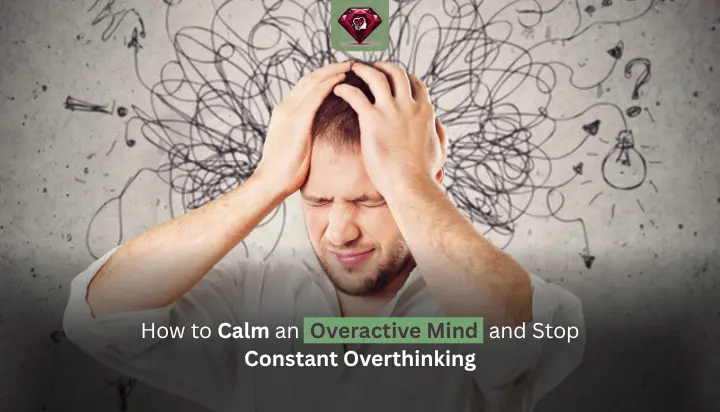
A hyperactive mind can be draining even if on the outside you are managing everyday chores adequately. Your thoughts can be non-stop, repetitive, and hard to quiet.
This is commonly called overthinking: repeating the past, worrying about the future, or keeping mentally “on” even when resting.
Over time, it might damage sleep, concentration, and emotional health. It’s not a character defect, but often a stress or worry response.
Let’s learn about why it happens and how to quiet it down in a practical approach.
What Is an Overactive Mind?
An overactive mind is a mental state with persistent, repeating thoughts that are difficult to calm down. Instead of the natural flow and ebb of thoughts, they feel frozen in motion.
In mental health terms, this often coincides with tendencies of worry, rumination, and cognitive over-engagement. The mind becomes concentrated on problem solving, forecasting events, or evaluating circumstances again and over, even when there is no urgent need to do so.
One of the hallmarks of a hyperactive mind is that it often feels uncontrollable. You may not want to think so much, yet the ideas go on nonetheless.
This is not just “thinking a lot.” Not so much intelligence or interest as the quality, intensity, and repetition of thoughts.
Why Your Mind Becomes Overactive
The mind is not hyperactive randomly. It is frequently linked to emotional stress, ingrained habits of thought, and the brain’s reaction to ambiguity.
Stress and the Brain’s Protection System
When you are stressed, your brain is just trying to keep you safe by keeping on alert. It starts scanning for problems, hazards, or what might go wrong. This is useful in case of true danger, but when stress becomes persistent, the brain might become stuck in this protective state.
Over time, it becomes a habit to keep checking even when you are safe mentally.
Anxiety and Uncertainty
Overthinking is a big part of anxiety. When the brain is uncertain, it seeks to alleviate that discomfort by thinking more. It implies that if you think long enough, you will achieve assurance or control.
The sad thing is that this backfires a lot. It produces more uncertainty than certainty.
Perfectionism and High Internal Standards
People who expect a lot from themselves are more prone to mental overactivity. The mind goes over decisions, tries to prevent mistakes, or replays circumstances to see whether something could have been done “better”.
It creates a cycle where nothing feels fully resolved.
Habitual Thinking Patterns
Overthinking can be a taught behavior too. When the mind has spent years analyzing, worrying, or planning too much, it begins to default to that mode automatically, even in peaceful situations.
Signs of an Overactive Mind
A hyperactive mind can reveal itself in numerous ways, and many people are not aware of how many symptoms are linked to the same pattern.
Emotionally, you can be feeling anxious, fidgety, or overwhelmed. Little concerns can weigh heavily on the mind.
Mentally, you are constantly overthinking. You could replay talks in your head or picture the worst-case situations, or struggle to make decisions since everything feels uncertain.
Stress is often held in the body physically. This can be headaches, stiff muscles, weariness, or difficulties sleeping when you are fatigued.
In everyday life, it could seem like being unable to rest without distraction, needing constant reassurance, or feeling mentally drained after ordinary chores.
The Hidden Impact of Constant Overthinking
Overthinking is more than a mental habit; it can damage your quality of life overall.
Mental exhaustionis one of the most typical impacts. When your brain is on all the time, there’s less room to focus, process emotions, or be present.
Sleep is often also disturbed. Many people with overactive minds say they lie in bed with racing thoughts and can’t switch off, even when they are physically fatigued.
Emotionally, overthinking can lead to increased concern, irritation, and stress sensitivity. Over time, this might lead to daily struggles feeling more burdensome than they really are.
Relationships can suffer as well. When your mind is occupied with analyzing or fretting, it is harder to be totally present with others.
Why “Just Stop Thinking” Doesn’t Work
A widespread misconception is that you can quit overthinking with force or willpower. In fact, the brain does not respond well to suppression.
When you try to shove thoughts away, your mind usually gets more alert to them. This is because the brain believes suppression is something essential that requires attention.
The idea is not to try to block thoughts but to change your relationship to thoughts. This is a basic notion in many treatments, including cognitive behavioral therapy and mindfulness-based approaches.
How to Calm an Overactive Mind
The aim of calming an overworked mind is not to make the thoughts disappear entirely. It’s about making room in your head so that thoughts don’t feel like too much.
Grounding Yourself in the Present
One of the best methods to slow down a busy mind is to softly redirect your focus to the current moment. This can assist in breaking the pattern of mental projection to the past or the future.
Simple grounding strategies include paying attention to physical sensations, focusing on your breath, or observing your surroundings non-judgmentally.
Reducing Mental Overload
An overactive mind is often made worse by too much mental stimulation. This can be frequent browsing, multitasking, or taking on too much all at once.
Cutting down cognitive overload provides your brain a break from having to digest new knowledge.
Creating Small Moments of Mental Pause
No need to spend hours in meditation to relax your thoughts. Even little breaks during the day might help refresh your mental state.
These times could be moments of sitting quietly, stepping away from screens, or just letting your mind rest without stimulation.
Challenging Thought Patterns Gently
Gently challenging thoughts rather than believing them as fact might be useful. Many thoughts are not actually true but are forecasts, assumptions, or anxieties.
The idea is not to debate with your mind, but to build a space between you and your thoughts.
Supporting Your Nervous System
A quiet mind is strongly related to a regulated nervous system. When your body feels protected, your mind quiets down automatically.
Eventually, sleep, hydration, mild movement, and routine can all help regulate the neurological system.
When Overthinking Becomes a Mental Health Concern
It becomes a problem when overthinking affects your ability to function in daily life. It may be constant anxiety, difficulty sleeping, constant worry, or emotional exhaustion that doesn’t go away with sleep.
If you find yourself constantly overwhelmed or having trouble managing your thoughts on your own, it may be good to seek professional help.
Therapy can help you learn better coping skills, reduce anxiety, and give you some structure and tools to help you understand what’s going on in your head. Also, it makes an environment where you don’t have to manage everything by yourself.
Ruby Reflections Mental Health offers supportive care for anxiety, overthinking, and emotional control in a safe and regulated environment.
Conclusion — A Calmer Mind Is Possible, Not Instant
An overactive mind can feel like something you are stuck with, but it is something that can be changed over time. But overthinking is generally an acquired reaction to stress, anxiety, or emotional overload, not a permanent state of mind.
With the right strategies and support, it is possible to create more mental space, reduce internal pressure, and experience moments of calm that feel more natural and consistent.
Progress is usually in little steps. The goal is not to stop having thoughts altogether, but to get to a place where they no longer run your emotions.
A calmer mind is not a mind that is thinking less, but it is about thinking with more ease.
FAQs
What causes an overactive mind?
Stress, worry, perfectionism, or a long-term tendency towards overthinking or mental hyperactivity can often produce an overactive mind.
Is overthinking a mental illness?
Overthinking isn’t a mental disorder, but it might be a sign of anxiety, sadness, or stress-related conditions.
Can therapy help with overthinking?
Yes. Therapy can help discover mental patterns, reduce anxiety, and provide practical tools to calm an overworked mind successfully.